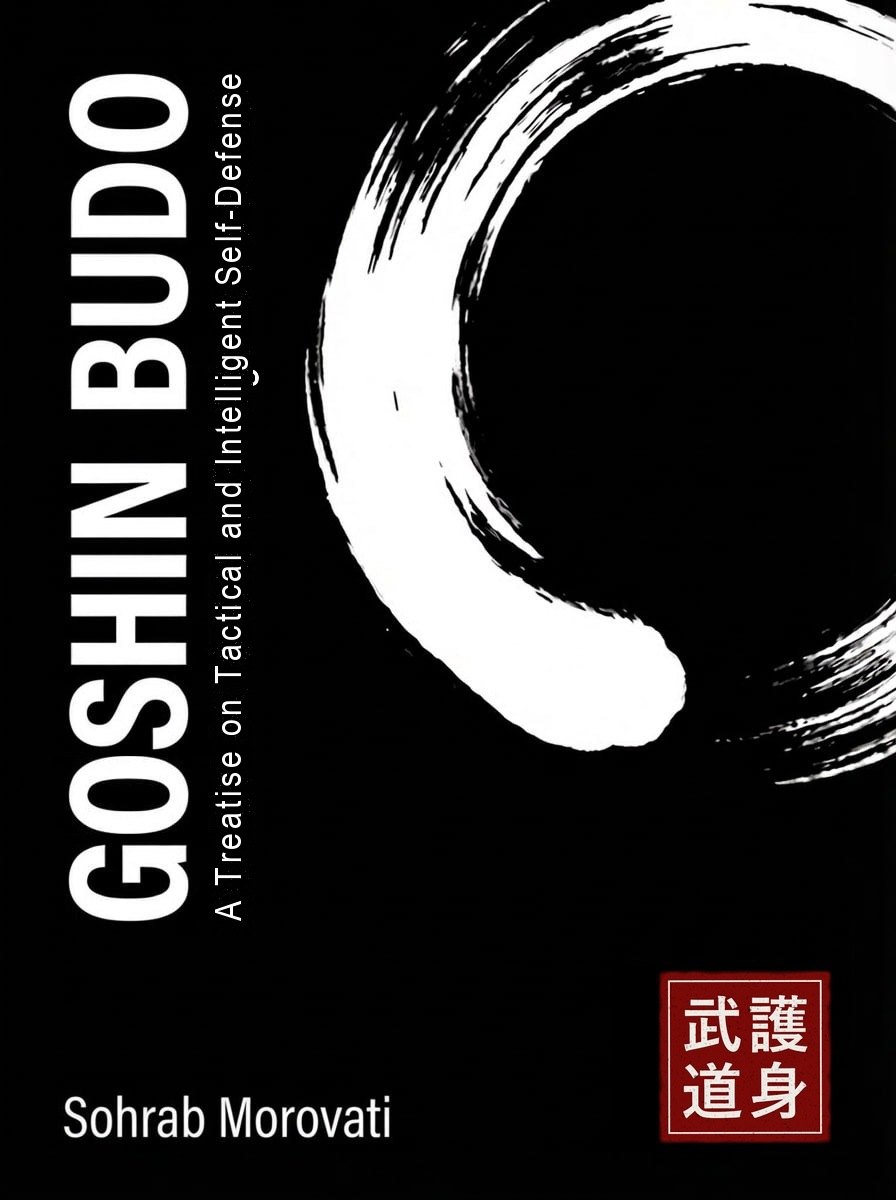
Goshin Budo
A Treatise on Tactical and Intelligent Self-Defense
Sohrab Morovati
Violence has outrun the understanding most people still carry of it. An entire population rehearses its defenses against a threat that has largely ceased to exist, while it stays blind to the one that actually surrounds it.
Goshin Budo does not train fighters. It trains survivors, and a survivor knows that the first minute is only the opening of the ordeal. After the assault come the investigation, the trial, the eyes of others, the fear that returns at night. The right move can save a life; one move too many can dismantle it as thoroughly as any blade.
Here the reader learns to tell social violence, which seeks status, from asocial violence, which seeks prey, and to decide according to the E/N/D Framework: evade first, neutralize when escape is cut off, and act decisively only as a last resort. The treatise gives him what he needs to hold his body steady when the heart races, to read a place before anything happens, and to choose techniques that still hold up when the hands shake.
The fight one never has is the only one without a price.
Open a self-defense branch without changing your style
We adapt martial arts and combat sports to self-defense, so that every style can open a self-defense branch within its own discipline. A master who adopts the Goshin Budo framework keeps his style and can become a WKKO self-defense affiliate by passing the Goshin theory test. He teaches his students what neither the mat nor the ring reproduces: reading violence before it breaks out, getting out first, answering to the court for every move. For WKKO self-defense certification, you train in Tactical Defense Combatives (TDC) with a representative of WKKO Ashigaru Honbu Dojo, then have your training validated by the WKKO’s national representative in your country: the certification is issued by the WKKO itself. Sohrab Morovati is one of these representatives, and he trains masters in every country. Full Spectrum Defense affiliation, for its part, requires certification in both Goshin Budo and Cognitive Budo.
The master keeps what he has built: his style, his techniques, his dojo, which the book calls the perfect laboratory for learning a complex technique. Goshin Budo adds what that laboratory cannot give, and its Chapter 7 sets out the program. It first selects the techniques that hold when the heart races—the ones that demand little fine motor control and aim at the tactical goal, not at a display of martial artistry. Then it carries them, over twelve weeks, from the static to the chaos: motor memory at a quarter of real speed; angles, timing and resistance that keep changing; wet concrete, near-darkness, an elevator, a thick jacket; and finally validation under maximum stress, the heart above a hundred and fifty beats per minute, with an audience and a camera, against several attackers and with a bystander to protect. Every scenario ends with recovery, debriefing and the training journal, because that is where the student learns from what he has just lived through. The style does not change its nature. It changes its ground.
No one learns this system alone, and the book says so: its legal disclaimer holds proper instruction and supervision to be essential. Its introduction also lays a duty on anyone who teaches: to pass on, along with the techniques, the ethical and legal frameworks that govern their use. A manual cannot hold a guard. A master can.
Your style stays yours
Goshin Budo adapts your style to self-defense. Your students learn when to act, which target to choose, how much force to use, and how to reach the objective and begin their way out within about two seconds.
A written doctrine
Goshin Budo gives your branch its doctrine: nine chapters, six annexes, the E/N/D Framework and the questions the court will ask of every move. Your instructors do not have to invent it.
New students
The book gives whole chapters to the city, the family and the workplace, and it lays out training programs for healthcare staff and retail staff. Your branch speaks to people who want neither a belt nor a podium. They want to get home.
An international network
As a WKKO self-defense affiliate, you join a network of dojos in more than fifty countries, whose members remain free to belong to their other organizations.
Goshin Budo is the title of a treatise by Sohrab Morovati for the Full Spectrum Defense school. It belongs to no school or federation that bears the name.
Two seconds to act, years to answer for it
In Japanese, goshin (護身) means protecting oneself, and budo (武道) the martial way. Goshin Budo is not one more fighting method. A system built to make fighters trains the body to win an exchange; Goshin Budo trains the whole person to come through danger without losing what makes a life worth defending: its relationships, its freedoms, its legal standing. The book calls the dojo the perfect laboratory for learning a complex technique, then names the trap inside it: a partner who follows the rules and genuinely wants you to succeed. On the street, nobody wants you to succeed.
The book prepares the practitioner for every stage of an assault, from the first sign to the years that follow. First, read it. Social violence seeks status, and de-escalation can often defuse it; asocial violence seeks prey, and the same gesture of appeasement that saves a life against the first forfeits it against the second. Next, decide, using the E/N/D Framework: evade wherever a way out exists; neutralize when escape is cut off, which means disrupting the attacker just enough to get away, never dominating him; act decisively only against an imminent threat of death or of permanent and serious injury. The framework holds when the heart climbs from seventy to more than a hundred and seventy-five beats per minute within seconds and clear thought has largely shut down, because a method that requires deliberation has already failed in a situation that forbids it. Then answer to the court, which will ask of every move whether it was reasonable, necessary and proportionate. Last comes the aftermath, which the book makes part of the method: legal, psychological and financial consequences that run on for months or years. The book says it in two sentences: “The encounter is rarely the gravest danger. The aftermath is.”
Goshin Budo claims no single style, which is why a karateka or a boxer can make it his own. Sohrab Morovati starts from a conviction: no tradition owns the whole answer to violence. Kyokushin, the combatives, the way of the sword and the redirection of force appear in his book as complementary readings of a single phenomenon, not as rivals. The book also takes down the wall people build between self-defense and combat. From one level of force to the next, most techniques stay the same, and only the target, the intensity and the follow-through change. Goshin Budo gives every move a threshold and a way out.
Over ninety styles under one roof
The WKKO was founded in 2005 in the Netherlands as a platform for traditional martial arts and combat sports alike, for modern fighting styles, for combatives and for personal protection systems. It describes itself as an independent umbrella body, chiefly for full contact karate and related styles; its dojos now teach in more than fifty countries, and a master joins on application, with his dojo or as an individual member. Membership is free: the WKKO charges no dues and sells no grades. In its acknowledgments, Goshin Budo honors Kancho Gerard Gordeau as the man who founded it and gathered more than ninety styles and systems into it, among them karate and kempo, jujutsu, kickboxing, wing chun, sambo, systema and krav maga. Kancho Gordeau built a structure in which traditions usually kept apart recognize one another as partial answers to a shared problem, and the book sees in that pluralism, well past any administrative arrangement, a philosophy of the martial path. The WKKO’s own style, Kenpokaikan, has a division it calls traditionally applied, which organizes self-defense lessons, educational work and certification; and of that style the WKKO writes that sport fighting is not self-defense, and that self-defense alone does not make a complete martial art. That gap, as we see it, is where you open your self-defense branch.
Tactical Defense Combatives is the international combatives organization founded by RP. Within the WKKO, it forms the combatives division: a self-defense system built from many combatives systems and martial arts, for training civilians, security staff, police and the military. RP gave Sohrab Morovati his understanding of the edged weapon and much of the combatives framing that runs through Goshin Budo. The TDC motto sets sport against survival, and we recognize in it the line Goshin Budo draws. TDC instructors teach in the ten countries shown in green on the map.
The WKKO and Tactical Defense Combatives (TDC) worldwide
- In green, the ten countries where Tactical Defense Combatives (TDC) instructors teach. All of them also have other WKKO styles, so they shift from green to blue.
- In blue, the WKKO beyond TDC: the countries where it teaches Combat Karate, Kenpokai, Kyokushin Budokai and its other styles.
Students and practitioners who so wish can take their TDC training with these instructors. Write to us to find out which representative of WKKO Ashigaru Honbu Dojo can train you.